

At a Glance
- Ancient Shiva shrine on Kathmandu’s Bagmati River, with inscriptions from the 5th century and older Puranic links
- No single founding date; the site shows centuries of rebuilding alongside nonstop worship
- 17th-century gilded pagoda with a four-faced lingam, inside a 264-hectare sacred complex
- Bhatta priests (South Indian lineage) keep daily rituals and major festivals alive
- UNESCO-listed (1979); cremation ghats and moksha beliefs remain central
The Pashupatinath Temple's historical significance begins not with a date but with stone. Lichhavi-era inscriptions, some traced to the 5th century CE, reference a shrine already ancient by the time they were carved. The temple stands on the western bank of the Bagmati River in Kathmandu, Nepal, covering a sacred precinct of 264 hectares, and its history spans more than a thousand years of continuous worship, reconstruction, royal patronage, and living ritual. No single founding moment exists. What exists instead is a layered accumulation of devotion, recorded in copper plate, carved in sandstone, and passed through generations of Bhatta priests whose lineage connects the inner sanctum to traditions drawn from South Indian Brahmin families. To speak of Pashupatinath Temple history is to speak of a site that has never stopped being used for the purpose it was built.
This is not a ruin. Not a monument preserved behind glass. The fires on the Arya and Bhasmeshwar ghats still burn. The four-faced lingam still receives Abhishekam each morning. And the belief that dying within sight of the temple's gilded spire releases the soul from the cycle of rebirth still shapes how families, sadhus, and pilgrims move through this landscape every single day.
The Ancient Origins of Pashupatinath Temple
The earliest physical evidence of Pashupatinath Temple history points to the Lichhavi period, roughly the 5th to 9th centuries CE, when the Kathmandu Valley was governed by kings who documented their devotion in copper and stone. An inscription attributed to King Jayadeva II, dated to the year 753 CE, records donations to the shrine. But the Skanda Purana, one of the eighteen Mahapuranas of Hindu scripture, mentions Pashupatinath in passages that scholars believe predate even the Lichhavi inscriptions by centuries.
The smell of woodsmoke and river silt still hangs over the Bagmati at dawn, the same air that would have greeted those early devotees.
It is told that Lord Shiva, weary of his abode at Mount Kailash, took the form of a deer and wandered into the forests of Mrigasthali along the Bagmati's eastern bank. When the gods pursued him, his horn broke into four pieces. One fragment became the sacred lingam at Pashupatinath, worshipped today with four faces gazing toward the four cardinal directions. This origin account, recorded across multiple Puranic texts, establishes Pashupatinath not merely as a temple but as a site where the divine chose to remain.
No one can fix an exact founding year. I think that's part of the point. The temple's authority doesn't rest on a single date but on the weight of accumulated centuries, each generation rebuilding what the previous one revered.
What the Lichhavi inscriptions confirm is that by the 5th century, Pashupatinath was already a major site of Shaiva pilgrimage, already administered by priestly orders, already receiving royal endowments. The shrine predates the inscriptions that describe it. How far back it reaches is a question the stone itself cannot fully answer.
Pashupatinath Temple Architecture Through the Centuries
The present pagoda, gilded in copper and gold, was raised in the 17th century under the patronage of the Malla kings. But the architectural footprint of the main temple follows a pattern far older, rooted in the Nepalese pagoda style that influenced sacred architecture across the Himalayan region and, some scholars argue, traveled as far as East Asia.
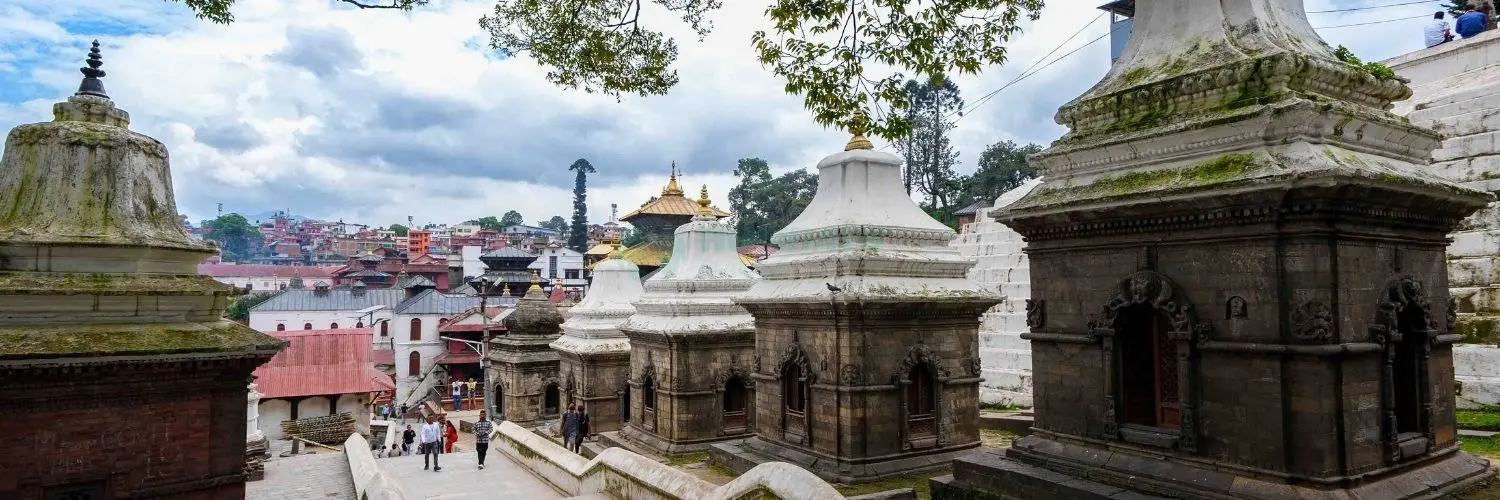
The main architectural features of Pashupatinath Temple include a two-tiered pagoda roof covered in gold-plated copper, four main doors (one on each cardinal face) plated in silver, and the inner sanctum housing the four-faced Shiva lingam. The temple sits on a raised stone platform accessed by steps from the Bagmati riverbank. Around it, within the 264-hectare sacred zone, stand hundreds of smaller shrines, including the Vasuki Nath shrine, the Guhyeshwari Temple (a Shakti Peetha), the 108 Shivalinga rows along the river terraces, and the Pandra Shivalaya complex of fifteen Shiva shrines built in the 15th century.
|
Feature |
Detail |
|
Roof style |
Two-tiered Nepalese pagoda, gold-plated copper |
|
Main doors |
Four cardinal doors, silver-plated |
|
Inner sanctum |
Four-faced (Chaturmukha) Shiva lingam |
|
Platform |
Raised stone, accessed from Bagmati bank |
|
Sacred zone |
264 hectares, hundreds of subsidiary shrines |
|
Major reconstruction |
17th century, Malla dynasty patronage |
The Pashupatinath Temple architecture tells its own chronology. The stone base belongs to one era. The metalwork to another. The wooden struts, carved with figures of deities and guardians, have been replaced and re-carved across centuries as monsoon, earthquake, and fire demanded renewal. After the 2015 Gorkha earthquake, which damaged several structures within the complex, restoration work was carried out under the supervision of the Pashupati Area Development Trust (PADT), the government body that administers the site.
I'd note that the temple's architectural continuity is not about preservation in a museum sense. It's about perpetual reconstruction in service of ongoing worship. The building changes. The practice doesn't.
Royal Patronage and the Malla and Shah Dynasties
Pashupatinath Temple history cannot be separated from the kings who funded, rebuilt, and politically legitimized it. The Lichhavi kings established the earliest documented royal connection. But it was the Malla dynasty, ruling the Kathmandu Valley from the 12th to the 18th century, that shaped the temple complex visitors see today.
King Shivadeva (early Lichhavi period) is credited with formalizing early temple structures. By the time of the later Malla kings, Pashupatinath had become the coronation temple of Nepal, the place where sovereignty was sanctified. No Malla king could claim the throne without receiving the blessing of Pashupati. This tradition continued under the Shah dynasty, which unified Nepal in the 18th century under Prithvi Narayan Shah. The Shah kings maintained Pashupatinath as the state temple, and the relationship between the monarchy and the shrine persisted until Nepal became a republic in 2008.
Royal patronage meant money, land, and institutional structure. The Bhatta priests, traditionally drawn from South Indian Brahmin lineages, were installed under royal decree and continue to perform the inner sanctum rituals to this day. Their presence is itself a historical artifact, a living link to a priestly tradition that has crossed regional and linguistic boundaries to serve a Himalayan shrine for centuries.
The scale of royal investment is visible in the subsidiary temples, the ghat infrastructure, the dharamshalas (pilgrim rest houses), and the formal processional routes that connect the main pagoda to the surrounding sacred landscape. These were not built by popular subscription alone. They required the treasury of a state that considered Pashupatinath its spiritual center.
And when the monarchy ended, the temple did not lose its status. The Pashupati Area Development Trust, established by the Government of Nepal, assumed administrative responsibility, ensuring that Pashupatinath Temple's historical continuity extended into the republican era without interruption.
The Bhatta Priests and the Ritual Lineage
One of the most distinctive features of Pashupatinath Temple history is the unbroken priestly lineage that serves the inner sanctum. The Bhatta priests are not Nepali by origin. They trace their lineage to South Indian Brahmin families, a connection established centuries ago under royal patronage and maintained through a tradition of appointment and succession that continues under PADT oversight.
Each morning, before the temple opens to devotees, the Bhatta priests perform the first Abhishekam on the four-faced lingam. The ritual sequence, which includes bathing the lingam with milk, honey, yogurt, and water, follows a liturgical order that has been transmitted orally and through practice across generations. The sound of bells and the low chanting of Vedic mantras fill the sanctum before the first light crosses the Bagmati.
Pashupatinath Temple rituals observed by the Bhatta priests include the daily cycle of four pujas (morning, midday, evening, and night), the Rudrabhishek (a specific Vedic ritual invoking Rudra, a form of Shiva), and special Abhishekam ceremonies during festivals. The Rudrabhishek is the ritual most sought by pilgrims who travel specifically for Pashupatinath Temple pilgrimage, particularly those completing a Jyotirlinga yatra across the subcontinent.
The Bhatta tradition raises a question that historians and religious scholars continue to discuss: how did a South Indian priestly lineage come to serve a Himalayan shrine? The most commonly cited explanation involves medieval-era royal invitations, where Malla or pre-Malla kings sought priestly expertise from established Shaiva centers in the south. The arrangement endured because it worked, spiritually and institutionally. The Bhatta priests brought liturgical precision. The kings provided land, income, and authority.
This is not a symbolic arrangement. The Bhatta priests live within the temple precinct. Their daily presence is as much a part of the site's historical fabric as the stone and copper of the pagoda itself.
Pashupatinath Temple Pilgrimage Across the Centuries
Pashupatinath is one of the principal Jyotirlingas of the subcontinent, a designation that places it among the most sacred Shiva shrines in the Hindu world. The exact number of Jyotirlingas varies by tradition (twelve is the most commonly cited count), but Pashupatinath's inclusion is consistent across major scriptural and devotional sources. This status has driven Pashupatinath Temple pilgrimage for centuries, drawing devotees from across Nepal, India, and the broader Hindu diaspora.
How does Pashupatinath Temple connect with Kedarnath? Both are Jyotirlinga sites. Both sit in the Himalayan zone. And both require pilgrims to cross significant geographic and physical thresholds to reach the sanctum. For devotees completing the full Jyotirlinga circuit, Pashupatinath and Kedarnath often appear in the same yatra itinerary, connected not by a single road but by the shared devotional logic that links all twelve sites into a single sacred geography.
The pilgrimage to Pashupatinath has always been shaped by the belief that dying within sight of the temple's spire releases the soul from samsara, the cycle of death and rebirth. This belief is not abstract theology. It has practical consequences. For centuries, elderly and terminally ill devotees have traveled to Pashupatinath specifically to spend their final days along the Bagmati. The Arya Ghat and Bhasmeshwar Ghat, where open-air cremation pyres have burned continuously for as long as anyone can document, exist because of this belief.
The cremation ghats are themselves a historical record. The ash, the stone steps worn smooth by water and foot traffic, the iron grates where pyres are built, all of it speaks to a practice that has not paused. Hindu beliefs about Pashupatinath center on this intersection of death, devotion, and liberation, and the ghats are where that intersection becomes physically visible.
Pilgrimage traffic intensifies dramatically during festivals, particularly Maha Shivaratri, when hundreds of thousands of devotees converge on the temple over a single night. But the daily rhythm of pilgrimage, the individual families arriving with offerings, the sadhus crossing the Bagmati to sit in the Mrigasthali ashrams, the quiet puja performed at dawn, this is the historical norm. The festivals are the peaks. The daily devotion is the baseline.
Pashupatinath Temple Festivals and Their Historical Roots
The main festivals celebrated at Pashupatinath Temple are not modern additions. Each one traces its roots to scriptural mandates, royal decrees, or traditions so old that their origins blur into oral history.
Maha Shivaratri is the largest. Held in February or March (the exact date follows the Hindu lunar calendar), it marks the night Shiva is believed to have performed the cosmic dance of creation and destruction. At Pashupatinath, the celebration draws between 800,000 and over a million devotثees in a single 24-hour period. Naga sadhus, Aghori ascetics, and Vaishnav holy men travel from across South Asia to gather at the temple. Fires burn on the ghats and in the courtyards through the night. The air fills with the smoke of dhuni fires, the sound of damaru drums, and the continuous chanting of "Om Namah Shivaya."
Bala Chaturdashi, observed in November or December, involves an all-night vigil followed by a dawn procession through the Mrigasthali forest, where devotees scatter seven types of grain along a prescribed route in memory of deceased family members. The ritual is specific to Pashupatinath. You won't find it at other Shiva temples.
Teej, celebrated primarily by women in August or September, brings fasting, prayer, and processions to the temple as married women pray for the longevity of their husbands and unmarried women pray for a good match.
Janai Purnima, the full moon festival in July or August, marks the renewal of the sacred thread (janai) worn by Brahmin and Chhetri men. At Pashupatinath, aثspecial gold and silver lingam is displayed for public darshan only on this day, a once-a-year event that draws its own dedicated pilgrimage.
|
Festival |
Typical timing |
Distinctive feature at Pashupatinath |
|
Maha Shivaratri |
February/March |
All-night worship, sadhu gathering, 800,000+ devotees |
|
Bala Chaturdashi |
November/December |
Dawn grain-scattering procession through Mrigasthali |
|
Teej |
August/September |
Women's fasting and prayer processions |
|
Janai Purnima |
July/August |
Display of gold and silver lingam for public darshan |
The Pashupatinath Temple festivals function as living historical events. Each one re-enacts, in real time, rituals that have been performed at this site for centuries. The liturgical calendar is itself a form of historical preservation, carrying forward practices that predate written records at the temple.
The Sadhus of Mrigasthali and the Ascetic Tradition
Cross the Bagmati on the footbridge east of the main pagoda and you enter Mrigasthali, the forested hillside where, according to tradition, Shiva wandered in the form of a deer. Today, Mrigasthali is home to ashrams, caves, and small shelters where sadhus, Hindu ascetic holy men, live year-round.
The sadhu communities at Pashupatinath include Naga sadhus (known for their ash-covered bodies and renunciation of clothing), Aghori sadhus (practitioners of extreme asceticism associated with cremation ground rituals), and Vaishnav sadhus (devotees of Vishnu who nonetheless honor Shiva at this site). Their presence is not seasonal or performative. Many have lived in the Mrigasthali caves for years, sometimes decades.
The ascetic tradition at Pashupatinath is part of the temple's historical identity. The Skanda Purana references ascetics practicing tapas (austerity) along the Bagmati. Lichhavi-era inscriptions mention donations to sadhu communities. The tradition of offering food, shelter, and ritual space to renunciants is as old as the temple itself, and it continues under the administration of PADT.
For visitors, particularly those with scholarly or documentary interest, the Mrigasthali ashrams represent one of the few places in the world where a living ascetic tradition can be observed in direct proximity to a major pilgrimage temple. The sadhus are not exhibited. They are participants in the same ritual ecosystem that includes the Bhatta priests, the cremation ghats, and the daily puja cycle.
I'd be cautious about photographing here without permission. The sadhus are real people living real lives of renunciation. Some welcome interaction. Others do not. Read the room. Or rather, read the cave.
Pashupatinath Temple Conservation and UNESCO Recognition
In 1979, the Pashupatinath Temple complex was inscribed as a UNESCO World Heritage Site as part of the broader Kathmandu Valley designation, which includes seven monument zones. The UNESCO listing recognized the site's "outstanding universal value" as a living religious complex with continuous historical significance spanning more than a millennium.
Pashupatinath Temple conservation has been a subject of ongoing attention, particularly after the 2015 Gorkha earthquake (magnitude 7.8), which caused structural damage to several buildings within the sacred zone. The main pagoda survived largely intact, but subsidiary shrines, walls, and ghat infrastructure required significant repair. Restoration efforts were coordinated by the Pashupati Area Development Trust in collaboration with the Department of Archaeology of the Government of Nepal.
The challenge of conservation at Pashupatinath is distinct from conservation at a museum or a ruin. The site is actively used. Cremation pyres burn daily. Thousands of devotees walk the stone paths. Monsoon rains erode exposed surfaces every year. Conservation here means maintaining a structure that is simultaneously ancient and in constant use, a building that must serve the living while honoring the dead.
PADT manages the 264-hectare sacred zone, overseeing everything from ghat maintenance to priest administration to environmental management of the Bagmati riverbank. The Bagmati itself has been the subject of cleanup campaigns, as pollution from upstream sources has affected water quality at the ghats. These efforts are ongoing and represent one of the more complex intersections of heritage preservation, environmental management, and active religious practice in South Asia.
The historical significance of Pashupatinath Temple is inseparable from its conservation status. A site that has been rebuilt, restored, and maintained across more than a thousand years does not survive by accident. It survives because each generation has chosen to invest in its continuation.
The Cremation Ghats and the Theology of Liberation
The Arya Ghat and Bhasmeshwar Ghat, located directly below the main temple on the Bagmati's western bank, are among the few places in the world where open-air Hindu cremation can be observed by visitors from across the river. The ghats are not a tourist attraction. They are a functioning cremation ground where families bring their dead, where priests perform the final rites, and where the belief in moksha (liberation from the cycle of rebirth) is enacted in fire, water, and ash.
The theology is direct. Hindu beliefs about Pashupatinath hold that cremation at the Arya Ghat, within sight of the temple's spire, grants the deceased direct passage to liberation. The Bhasmeshwar Ghat, slightly downstream, serves a similar function but is traditionally used for those of lower social standing. Both ghats have been in continuous use for centuries.
The heat of the pyres, the sound of wood cracking, the smell of sandalwood and burning cloth, these are not metaphors. They are the sensory reality of a ritual that connects the present moment to a theological tradition recorded in the Garuda Purana and practiced at this specific riverbank for longer than anyone can precisely date.
What rituals can be observed at Pashupatinath Temple? The cremation rites are the most visible from the public terraces on the east bank. But the daily puja cycle inside the main pagoda, the evening aarti ceremony, and the special Abhishekam rituals performed by the Bhatta priests are all observable (the inner sanctum is restricted to Hindus, but much of the temple complex is accessible to all visitors).
The ghats also connect Pashupatinath to the broader Hindu geography of sacred rivers. The Bagmati flows into the Ganges system, and cremation here carries the same theological weight as cremation at Varanasi's Manikarnika Ghat. For pilgrims completing a Jyotirlinga yatra, the connection between Pashupatinath and the sacred river network is not incidental. It is structural.
Pashupatinath in the Context of Subcontinental Shiva Worship
Pashupatinath does not exist in isolation. It is a node in a network of Shiva worship that spans the Indian subcontinent, from Kedarnath in the Garhwal Himalayas to Rameshwaram at the southern tip of Tamil Nadu. The historical significance of Pashupatinath Temple is amplified by its position within this network, particularly its status as a Jyotirlinga.
The Jyotirlinga tradition holds that Shiva manifested as an infinite column of light (jyoti) at twelve (or, in some traditions, more) locations across the subcontinent. Each Jyotirlinga site represents a place where the divine presence is believed to be especially concentrated. Pashupatinath's inclusion in this list places it alongside Kashi Vishwanath (Varanasi), Somnath (Gujarat), Mahakaleshwar (Ujjain), and Kedarnath (Uttarakhand), among others.
How does Pashupatinath Temple connect with Kedarnath? Both are Himalayan Jyotirlinga sites. Both require pilgrims to travel into mountainous terrain. Both are associated with Shiva in his aspect as lord of the natural world (Pashupati means "lord of animals," while Kedarnath sits at 3,583 meters in the high Himalayas). For devotees who undertake the full Jyotirlinga pilgrimage circuit, visiting both sites in sequence is common, often combining Pashupatinath with a broader Nepal-India itinerary.
The subcontinental context also explains the presence of the Bhatta priests. Their South Indian Brahmin lineage connects Pashupatinath to the Shaiva traditions of the Deccan and Tamil Nadu, creating a priestly bridge between Himalayan and peninsular forms of Shiva worship. This is not a modern arrangement. It is a historical reality that has persisted for centuries, reflecting the way pilgrimage, patronage, and priestly migration have always operated across the subcontinent.
The Living Temple in the Modern Era
Pashupatinath entered the 20th century as the state temple of a Hindu monarchy. It enters the 21st century as a UNESCO World Heritage Site administered by a government trust in a federal republic. The political framework has changed. The ritual life has not.
The daily schedule remains anchored to the four pujas performed by the Bhatta priests. The temple's daily rituals and aarti timings follow a pattern that has been maintained across political transitions, earthquakes, and even the COVID-19 pandemic, during which the temple briefly closed to the public but continued internal worship.
Maha Shivaratri continues to draw hundreds of thousands of devotees annually. The sadhu communities in Mrigasthali continue to grow during festival season and maintain a year-round presence. The cremation ghats continue to burn. And the Pashupatinath Temple pilgrimage continues to bring families, scholars, and seekers from across the world to a riverbank in Kathmandu where the boundary between the historical and the sacred has never been clearly drawn.
The temple's modern administration faces real challenges: Bagmati River pollution, infrastructure strain from mass pilgrimage events, the ongoing need for structural conservation, and the complex task of balancing open access with the protection of sacred spaces. These are not new problems. Every generation that has cared for Pashupatinath has faced its own version of the same question: how do you maintain a living shrine across the pressures of its own time?
The answer, so far, has been continuity. Not preservation in amber, but active, ongoing, sometimes imperfect renewal. The temple has been rebuilt after fire, after earthquake, after political upheaval. It has absorbed new priestly lineages, new administrative structures, and new categories of visitor. And it has continued to function as exactly what it has always been: the holiest Shiva shrine in Nepal, a place where pilgrimage, cremation, devotion, and daily worship converge on a single stretch of sacred riverbank.
Pashupatinath Temple Historical Significance in Summary
Pashupatinath Temple's historical significance rests on three pillars: documented antiquity reaching back to at least the 5th century CE with Lichhavi-era inscriptions and Puranic references that suggest an even older origin; unbroken ritual continuity maintained by the Bhatta priestly lineage and the daily puja cycle within the inner sanctum; and active sacred function, from the cremation ghats to the Maha Shivaratri gathering, that makes the temple not a relic of history but a participant in it. The 264-hectare UNESCO-designated precinct on the Bagmati River in Kathmandu remains, as it has been for over a thousand years, a threshold where devotion, death, and liberation meet in a single living landscape.
Frequently Asked Questions
What is the historical significance of Pashupatinath Temple?
The historical significance of Pashupatinath Temple lies in its enduring role as a major site of Shaiva pilgrimage and worship for over a thousand years. This continuity is reflected in its architecture, rituals, and the unbroken lineage of Bhatta priests. The temple's history is a testament to continuous devotion, royal patronage, and cultural heritage.
What are the main architectural features of Pashupatinath Temple?
Pashupatinath Temple's architecture includes a two-tiered pagoda roof covered in gold-plated copper and silver-plated doors on each cardinal face. The inner sanctum houses a four-faced Shiva lingam. The temple is surrounded by numerous smaller shrines, reflecting a blend of historical styles and religious influences.
What rituals can be observed at Pashupatinath Temple?
Visitors can observe daily pujas performed by the Bhatta priests, the Rudrabhishek ritual, and the evening aarti ceremony. The temple's rituals are deeply rooted in Vedic traditions, with special ceremonies conducted during major festivals and specific auspicious days.
What are the main festivals celebrated at Pashupatinath Temple?
The main festivals at Pashupatinath Temple include Maha Shivaratri, Bala Chaturdashi, Teej, and Janai Purnima. Each festival has its unique rituals and draws large numbers of devotees, reflecting the temple's historical and cultural significance.
How does Pashupatinath Temple connect with Kedarnath?
Pashupatinath and Kedarnath are both Jyotirlinga sites, significant in the Hindu tradition for their connection to Shiva. They are part of the sacred geography of the subcontinent, attracting pilgrims who often visit both as part of a broader spiritual journey.
Certifications
- UNESCO World Heritage Site (1979): Pashupatinath Temple is part of the Kathmandu Valley UNESCO World Heritage designation, recognizing its continuous religious and historical significance.