

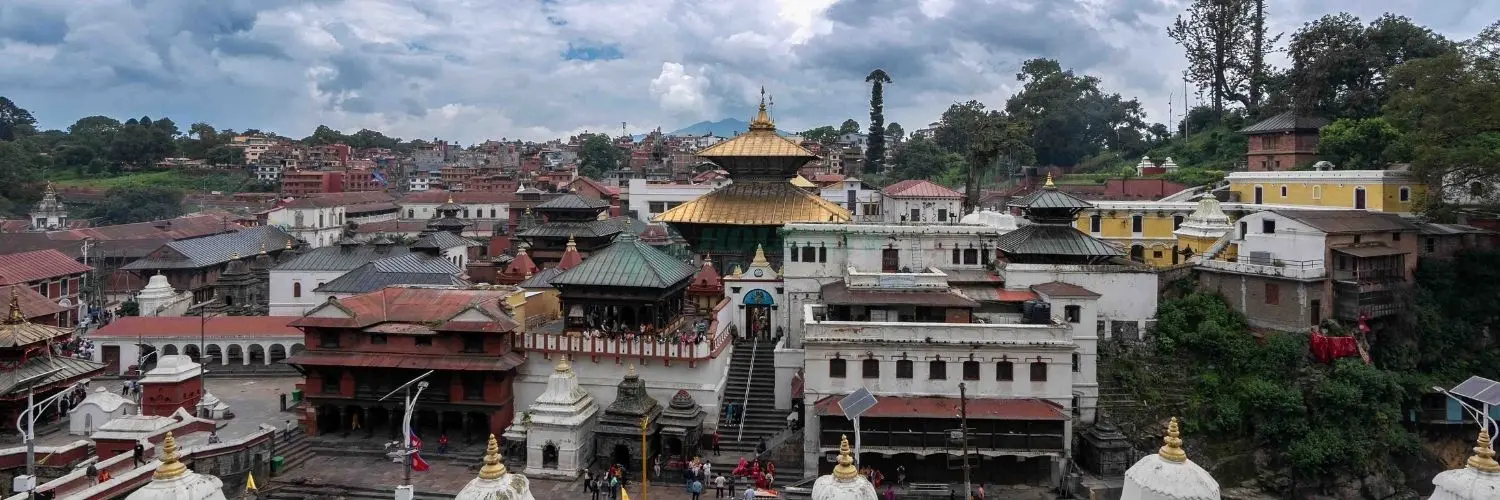
At a Glance
- Pashupatinath’s core legend says Shiva hid as a deer; his broken horn became the four-faced sacred lingam.
- Ancient sources (Skanda Purana, Lichhavi inscriptions) tie the shrine to long-running worship and royal support.
- The Bagmati River and cremation ghats reflect a strong belief in liberation through death rites here.
- The 264-hectare UNESCO complex blends pagoda architecture, forest ascetics, serpent and goddess shrines, and major festivals.
The significance of Pashupatinath Temple begins not with stone or mortar but with a story about a god who wanted to disappear. It is told that Lord Shiva, weary of the celestial courts of Kailash, descended to the forested banks of the Bagmati River in the form of a deer. He wandered the hills of Mrigasthali, grazing in solitude, unrecognized. When the other gods finally tracked him down and seized him by the horn, it shattered into four pieces. One fragment became the sacred lingam now worshipped in the inner sanctum of Pashupatinath, its four faces gazing outward toward the four cardinal directions. That single act of divine escape, and the violence of recapture, gave this site its oldest and most defining legend. And the lingam has remained here, through earthquakes, invasions, and a thousand monsoon seasons, on the eastern bank of the Bagmati in the Deopatan neighborhood of Kathmandu, Nepal.
The Pashupatinath history stretches back well over a millennium. Mentions of the shrine surface in Lichhavi-era inscriptions and in the pages of the Skanda Purana. The present pagoda, gilded in copper and gold, was raised in the 17th century, but it sits on ground that has been considered sacred far longer than any surviving structure can account for. The complex today spans 264 hectares, recognized as a UNESCO World Heritage Site since 1979, encompassing temples, ashrams, cremation ghats, and forest. To understand why this particular bend in a particular river in the Kathmandu Valley holds such weight, you have to go back to the legends themselves.
This is a place where stories are not decorative. They are structural. Every ritual performed inside the sanctum, every pyre lit on the Arya Ghat, every sadhu sitting cross-legged in the Mrigasthali caves, traces back to a narrative thread that is centuries old and still pulling.
The Deer God and the Broken Horn: Pashupatinath's Origin Legend
The foundational legend of Pashupatinath Temple concerns Shiva in his form as Pashupati, the Lord of Animals. The story holds that Shiva, dissatisfied with the formality of his divine seat at Mount Kailash, took the shape of a one-horned deer and fled to the forests along the Bagmati. He grazed among the trees of Mrigasthali (the name itself means "deer forest"), content to live as a creature of the wild, anonymous and unbothered.
The gods grew anxious. Shiva's absence disrupted the cosmic order. They descended to the Bagmati valley, found him, and grabbed him by his single horn. The horn broke.
Four fragments. Four faces. The lingam that emerged from this act of divine struggle is the Mukhalingam of Pashupatinath, and it remains the most sacred object in the inner sanctum today. Each of its four faces represents a different aspect of Shiva: Sadyojata (west), Vamadeva (north), Aghora (south), and Tatpurusha (east). A fifth face, Ishana, is said to be invisible, facing skyward. The full body of Pashupatinath Temple legends revolves around this single object and the moment of its creation.
I think what makes this origin story so persistent is its strangeness. This isn't a god arriving in triumph. It's a god running away, being caught, and leaving behind a broken piece of himself. The Pashupatinath Temple significance, at its root, comes from that tension between divine freedom and divine obligation.
The Bhatta priests, traditionally drawn from South Indian Brahmin lineages, perform the daily rituals on this very lingam. The Rudrabhishek and Mahamrityunjaya puja, both available to devotees (bookings open at 4:30 AM at the south office), are conducted in direct contact with the Mukhalingam. The rituals haven't moved. The object hasn't moved. The story hasn't changed.
Pashupatinath History in the Skanda Purana and Lichhavi Inscriptions
The earliest textual references to Pashupatinath appear in the Skanda Purana, one of the eighteen Mahapuranas of Hindu scripture. The Skanda Purana describes the Bagmati as a river of liberation and names Pashupatinath as a site where Shiva's presence is permanently fixed. These are not casual mentions. The text frames the temple as one of the principal Jyotirlingas of the subcontinent, a self-manifested lingam of light, and assigns it a specific role in the geography of salvation.
Lichhavi-era inscriptions, dating from roughly the 5th to 9th centuries CE, confirm that the temple was already a functioning center of worship and royal patronage during that period. Stone inscriptions found in and around the Kathmandu Valley reference donations, land grants, and ritual obligations connected to the Pashupatinath shrine. The Lichhavi kings treated the temple not as a local shrine but as a state institution, a place where political legitimacy and divine sanction intersected.
What's worth noting is the gap between these inscriptions and the present structure. The pagoda you see today, with its copper and gold gilding, dates to the 17th century. But the site itself predates that structure by many centuries. The history and origin of Pashupatinath Temple is a layered thing: oral tradition reaching back into mythic time, textual references from the Puranic period, epigraphic evidence from the Lichhavi dynasty, and architectural evidence from the Malla and later periods. No single source tells the whole story. Each confirms a different layer.
The documented Pashupatinath Temple history is best understood as a palimpsest. The same ground, rewritten by each generation, but never erased.
The Lichhavi Royal Connection
The Lichhavi kings did not simply patronize the temple. They built their political identity around it. Inscriptions from this era describe the king as a servant of Pashupati, and royal decrees were issued in the god's name. The temple was, in effect, the spiritual center of the state. This is not a metaphor. Land revenues were directed to the temple's maintenance, and the Bhatta priesthood operated under royal charter.
The altitude of the site, at 1,400 meters in the Kathmandu Valley, placed it at the crossroads of trade routes and pilgrimage paths connecting the Indian plains to the Tibetan plateau. Its position on the Bagmati, about 5 km northeast of the city center, made it accessible but distinct from the urban core. Pilgrims arrived from the south. Traders passed through. The temple accumulated both devotion and wealth.
The Bagmati, the Ghats, and the Legend of Liberation
To die within sight of the spire of Pashupatinath is believed to release the soul from the cycle of rebirth. This belief is not incidental. It is the reason the cremation ghats exist on the Bagmati riverbank, and it is the reason families have brought their dead here for centuries. The Arya Ghat, reserved historically for royal cremations, and the Bhasmeshwar Ghat, used for public cremations, are both active. Open-air pyres burn on the stone platforms along the water's edge, and the ashes are released into the Bagmati.
The river itself carries its own mythic weight. In Puranic geography, the Bagmati is considered a tributary of spiritual power, a river that washes away the accumulated karma of the dead. The act of cremation at Pashupatinath is not simply disposal of the body. It is a ritual of release, performed at a specific location because that location is believed to have specific metaphysical properties. The Pashupatinath Temple rituals associated with death and cremation are inseparable from the legends that gave the site its sacred status.
Photography is forbidden at active cremation ghats. This is not a suggestion. It is a boundary that reflects the seriousness with which the rites are treated.
The Mahamrityunjaya puja, available at NPR 2,500, is directly connected to this tradition. The mantra itself, the "death-conquering" invocation, is performed within the temple complex as an act of spiritual protection for the living and liberation for the dead. For families completing a Jyotirlinga yatra in memory of a loved one, this puja and this location carry a weight that no other site can replicate.
The Surya Ghat and Morning Bathing Rites
Not all activity on the Bagmati ghats concerns death. The Surya Ghat is used for morning bathing, a daily ritual of purification that draws local devotees before dawn. The smell of the river at that hour, the cold of the water at 1,400 meters elevation in winter, the sound of mantras spoken quietly against the current: these are the sensory textures of a place that functions as both cremation ground and living bath.
The contrast is deliberate. Birth, death, purification, and release all happen within a few hundred meters of each other along the same riverbank. The Pashupatinath Temple significance is architectural and scriptural, yes, but it's also spatial. The layout of the ghats tells you what the temple believes about the relationship between the body and the soul.
Mrigasthali: The Forest Where Shiva Hid
Across the Bagmati from the main pagoda, the forested hill of Mrigasthali rises steeply. This is the deer forest of the origin legend, the place where Shiva grazed in animal form before the gods found him. Today, it is home to ashrams, caves, and a community of sadhus who live year-round on the temple grounds.
Naga sadhus, Aghori practitioners, and Vaishnav ascetics occupy the Mrigasthali caves and surrounding shelters. Some have been there for decades. The forest is not a museum exhibit or a curated experience. It is a functioning ascetic community, and the sadhus are not performers. They are residents. Their presence is a direct continuation of the legend that placed Shiva in this forest, choosing solitude over sovereignty.
The Mrigasthali deer park, which still exists within the complex, adds a literal dimension to the mythic one. Deer graze on the hillside. The forest is dense enough to feel removed from the city, even though Kathmandu's urban edge is less than 5 km away. Walking through Mrigasthali in the early morning, with mist rising off the Bagmati below and the sound of temple bells carrying across the water, you understand why the legend chose this particular setting.
I'd honestly recommend crossing the river and spending at least an hour on the Mrigasthali side before approaching the main pagoda. The perspective is different. You see the gold roof from a distance, framed by forest and river, and the scale of the 264-hectare complex becomes real in a way it doesn't from the entrance gate.
The religious and cultural significance of Pashupatinath Temple is not confined to the inner sanctum. It extends into the forest, the river, the ghats, and the caves. The sacred geography is theology.
Pashupatinath Architecture: The Pagoda and Its Symbolic Language
The main pagoda of Pashupatinath is a two-tiered structure, its roof gilded in copper and gold, rising above the western bank of the Bagmati. The architectural features of Pashupatinath Temple follow the Nepalese pagoda style, with carved wooden struts (tundala) supporting the overhanging roofs. These struts depict deities, mythological scenes, and erotic figures, a convention shared with other Kathmandu Valley temples but executed here with particular density and refinement.
The four doors of the sanctum face the four cardinal directions, corresponding to the four visible faces of the Mukhalingam inside. The silver-plated doors on the western entrance are the primary access point for the Bhatta priests. Non-Hindus may not enter the inner sanctum. The view from across the river, looking east toward the main entrance, is the closest most international visitors will get.
The Pashupatinath architecture tells a specific story. The pagoda is not simply a shelter for the lingam. It is a cosmological diagram. The two tiers represent earth and heaven. The gilded pinnacle (Gajur) represents the axis mundi, the center of the world. The four doors and four faces establish the temple as a point of orientation for the entire valley. The building is a map.
The 108 Shivalinga Row and Pandra Shivalaya
Along the riverbank, downstream from the main pagoda, a row of 108 small stone shivalingas line the ghat. Each one is individually carved and set into its own miniature shrine. The number 108 is sacred in Hindu tradition (the number of beads on a mala, the number of Upanishads in some counts, the number of names of Shiva in certain texts). Walking the row takes maybe ten minutes if you go slowly. The stone is worn smooth by centuries of touch and water.
The Pandra Shivalaya, a set of fifteen small Shiva shrines, sits nearby. These were built during the Malla period and represent a condensed pilgrimage: visiting all fifteen is considered equivalent to visiting fifteen separate Shiva temples across the subcontinent. The practical genius of this arrangement is obvious. Not everyone can travel to every Jyotirlinga. The Pandra Shivalaya brings the pilgrimage to the pilgrim.
These secondary structures are often overlooked by visitors focused on the main pagoda, but they carry their own Pashupatinath Temple legends. Each of the fifteen shrines is associated with a specific manifestation of Shiva and a specific geographic location. The Pandra Shivalaya is, in miniature, a sacred map of the subcontinent.
The Vasuki Nag Legend and the Serpent Shrine
Behind the main pagoda, smaller and easier to miss, sits the Vasuki Nath shrine. The legend here concerns Vasuki, the king of serpents (nagas), who is said to have served as the rope during the churning of the cosmic ocean (Samudra Manthan) in Hindu mythology. Vasuki's connection to Pashupatinath is specific: the serpent is considered a guardian of the site, coiled around the lingam in spiritual protection.
The Vasuki shrine is one of the major Pashupatinath attractions, though "major" is relative. It's small. A handful of visitors at most. But the iconography is dense, with carved serpent motifs covering the exterior, and the ritual activity there is continuous. Devotees offer milk and flowers to the naga deity, particularly during Nag Panchami, the annual serpent festival observed in July or August.
The serpent motif recurs throughout the complex. Naga figures appear on the struts of the main pagoda, on the ghats, and in the Mrigasthali forest shrines. They are not decorative. In the cosmology of the site, nagas are boundary guardians, protectors of thresholds between the human world and the divine. The entire Pashupatinath complex is, in a sense, a threshold, and the nagas are its sentinels.
Guhyeshwari: The Secret Goddess Within the Complex
About 1 km east of the main pagoda, deeper into the complex and closer to the Mrigasthali forest, stands the Guhyeshwari Temple. This is one of the Shakti Pithas, sites where parts of the goddess Sati's body are believed to have fallen after her self-immolation and the subsequent dismemberment of her corpse by Vishnu's Sudarshana Chakra. The legend holds that Sati's knees fell at this location.
Guhyeshwari is a tantric shrine. Its rituals and iconography differ markedly from the Shaivite worship at the main pagoda. The temple is small, partially subterranean, and restricted to Hindu devotees. But its presence within the Pashupatinath complex is theologically important: it establishes the site as a place where both Shiva and Shakti are present, where masculine and feminine divine principles coexist within the same sacred landscape.
The walk from the main pagoda to Guhyeshwari takes you along the riverbank, past the cremation ghats, through a stretch of forest, and into a quieter, less-visited part of the complex. If you're a Hindu devotee with access, the combination of darshan at both shrines, Pashupatinath and Guhyeshwari, constitutes a complete pilgrimage circuit within the 264-hectare site.
The Pashupatinath Temple rituals at Guhyeshwari are distinct. Tantric worship involves different mantras, different offerings, and a different relationship between devotee and deity. The two temples, separated by less than a kilometer, represent two different theological traditions operating within a shared sacred geography. This coexistence is itself a kind of legend, a story about how Hinduism holds contradictions together without resolving them.
Festivals and the Living Legend: Maha Shivaratri at Pashupatinath
The festivals celebrated at Pashupatinath Temple are not commemorations of dead history. They are reenactments of living legend. Maha Shivaratri, observed in February or March, is the largest. On this night, hundreds of thousands of devotees converge on the temple complex. Sadhus arrive from across the subcontinent. Fires burn on the ghats until dawn. The air fills with the sound of bells, drums, and chanting.
Maha Shivaratri marks the night Shiva performed the Tandava, the cosmic dance of creation and destruction. At Pashupatinath, the night is observed with an all-night vigil (jagaran), continuous chanting of Shiva's names, and special Abhishekam of the Mukhalingam in the inner sanctum. The Bhatta priests perform rituals through the night. The Bagmati Aarti, normally held at 6:15 PM daily for approximately 45 minutes, takes on a different scale and intensity during Shivaratri.
But Shivaratri is not the only festival. Teej brings women devotees in red saris, fasting and praying for marital blessing. Bala Chaturdashi, observed in November or December, involves an all-night vigil followed by a dawn procession through the Mrigasthali forest, scattering seven types of seeds along a prescribed route. Janai Purnima marks the changing of the sacred thread. Each festival reactivates a different layer of the Pashupatinath Temple legends, connecting present-day ritual to ancient narrative.
The Pashupatinath Temple festivals are, honestly, the most direct way to experience the significance of the site if you're visiting for the first time. The legends are abstract until you see them performed. October through March offers the best conditions for visiting (crisp Himalayan light, lower humidity), and Shivaratri falls within that window.
The Bala Chaturdashi Seed Ritual
Bala Chaturdashi deserves its own mention because it's one of the more unusual Pashupatinath Temple rituals. The legend behind it involves a demon named Bala who terrorized the Bagmati valley until Shiva destroyed him. Devotees observe the night with a vigil at the temple, then walk a specific path through the Mrigasthali forest at dawn, scattering seeds (saat biu) at designated spots. Each spot corresponds to a deceased family member. The seeds are believed to nourish the souls of the dead.
The route through Mrigasthali during Bala Chaturdashi is the same forest where Shiva hid as a deer. The same ground. The same trees, or their descendants. The ritual physically retraces the origin legend while simultaneously performing a rite for the dead. Past and present, myth and mourning, occupy the same path.
The Bhatta Priesthood: A Living Lineage
The Bhatta priests of Pashupatinath are traditionally drawn from South Indian Brahmin lineages. This is not a recent arrangement. The tradition of appointing Bhatta priests from the southern subcontinent dates back centuries and reflects the pan-Indian significance of the temple. The priests are not local Nepali Brahmins. They are specialists, brought to Pashupatinath specifically because of their training in Shaivite ritual and their lineage qualifications.
The Bhatta priests perform the inner sanctum rituals daily. The Rudrabhishek (NPR 1,500) and the Mahamrityunjaya puja (NPR 2,500) are among the most requested ceremonies. Special sankalpa pujas are available on request. Bookings open at 4:30 AM at the south office.
The significance of Pashupatinath Temple is inseparable from the continuity of this priesthood. The rituals are not improvised. They follow prescribed sequences, mantras, and offerings that have been transmitted within the Bhatta lineage for generations. The priests are, in a sense, living carriers of the temple's legends, performing the same acts of worship on the same lingam that the stories describe.
Non-Hindus cannot enter the inner sanctum. This restriction is not arbitrary. The sanctum is a ritual space, not an exhibition space. The boundary between observer and participant is clearly drawn, and it reflects the temple's understanding of sacred access. You can view the main shrine from across the river, and the Bagmati Aarti at 6:15 PM daily is accessible to all visitors.
The Cremation Ghats as Sacred Narrative
The open-air cremation ghats on the Bagmati are among the few such living rites still accessible to outside observers at any UNESCO World Heritage Site. The Arya Ghat and Bhasmeshwar Ghat operate continuously. Families bring their dead. The pyres are built from stacked wood. The body is washed in the Bagmati before cremation. The eldest son lights the fire.
This is not a spectacle. It is the final chapter of the Pashupatinath legend of liberation: the belief that cremation at this site, within sight of the golden spire, releases the soul from samsara. The entire theological architecture of the temple, from the origin legend of the broken horn to the Puranic descriptions of the Bagmati as a river of karma-cleansing power, converges on the ghats. The cremation is the legend made physically.
The smell of sandalwood and burning wood carries across the river. The heat of the pyres is real. The grief of the families is real. The Pashupatinath Temple visitors' experience at the ghats is not comfortable, and it's not meant to be. It is an encounter with a tradition that treats death as a sacred event, performed in public, on the banks of a holy river, at the foot of a god's shrine.
Photography is forbidden at active cremation ghats. Respect this completely.
The complete Pashupatinath Temple guide covers visitor guidelines, entry fees, and practical details for planning your visit. Nepali and Indian citizens enter free. SAARC nationals pay NPR 200. Other foreign nationals pay NPR 1,000.
The Aarti on the Bagmati: Daily Ritual as Living Story
Every evening at 6:15 PM, the Bagmati Aarti begins on the riverbank below the main pagoda. The ceremony lasts approximately 45 minutes. Priests hold flaming lamps, circling them in prescribed patterns while mantras are chanted. The light reflects off the water. The sound of bells fills the ghat.
The Bagmati Aarti is the daily climax of the temple's ritual cycle. It is not a performance for visitors. It is a scheduled act of worship that happens whether anyone is watching or not. But for visitors, it is the most accessible and most concentrated expression of the Pashupatinath Temple rituals. The aarti condenses the temple's entire theological narrative, the presence of Shiva, the sacred river, the fire, the offering, into 45 minutes of visible, audible, tangible worship.
The best viewing position is from the terraced steps on the eastern bank, across the river from the main pagoda. Arrive 20 minutes early. The steps fill quickly, especially during festival season. The golden roof of the pagoda catches the last light of the afternoon as the aarti begins. That visual, the gilded spire against a darkening sky, oil flames reflected in the Bagmati, is the image that most visitors carry away from Pashupatinath.
The Significance of Pashupatinath Temple in the Jyotirlinga Tradition
Pashupatinath is recognized as one of the principal Jyotirlingas, the self-manifested lingams of light that mark the most sacred Shiva sites across the subcontinent. The Jyotirlinga tradition holds that Shiva appeared as an infinite column of light at twelve (or, in some traditions, more) locations, and that the lingam at each site is a fragment of that original radiance.
The Pashupatinath Mukhalingam, with its four carved faces, is distinct among Jyotirlingas. Most Jyotirlingas are aniconic, simple cylindrical stones without facial features. The four-faced form at Pashupatinath connects it directly to the origin legend of the broken horn and the four fragments. The architectural features of Pashupatinath Temple, from the four doors of the sanctum to the orientation of the pagoda, are designed to reflect and reinforce this four-directional symbolism.
For pilgrims completing a Jyotirlinga yatra, Pashupatinath is often the most emotionally significant stop. It is the only Jyotirlinga outside India. Reaching it requires crossing an international border, traveling to Kathmandu (Tribhuvan International Airport is 4 km away, a 15-minute taxi ride), and entering a complex that is both familiar in its Hindu ritual grammar and distinctly Nepali in its architectural and cultural expression.
The Pashupatinath Temple significance within the Jyotirlinga tradition is not simply a matter of inclusion on a list. It is a recognition that this site, on this river, in this valley, holds a particular and irreplaceable position in the sacred geography of Shaivism.
Continuity as the Deepest Legend
The most remarkable thing about Pashupatinath is not any single legend. It is the fact that the legends are still being lived. The Bhatta priests still perform the Rudrabhishek on the same Mukhalingam. The cremation ghats still burn. The sadhus still inhabit the Mrigasthali caves. The Bagmati Aarti still begins at 6:15 PM. The festivals still draw hundreds of thousands. The deer still graze on the hillside where Shiva is said to have hidden.
This continuity, over a thousand years of unbroken ritual practice at a single site, is the deepest Pashupatinath Temple legend. Not a story told about the past, but a story being performed in the present. The 264-hectare complex, administered by the Pashupati Area Development Trust under the Government of Nepal, is not a heritage site in the usual sense. It is a living religious institution that happens to also be a UNESCO World Heritage Site.
The Pashupatinath history is not finished. It is still being written, in the smoke of the cremation pyres, in the mantras of the Bhatta priests, in the footsteps of pilgrims crossing the Bagmati at dawn. The legends are not relics. They are instructions, performed daily, at a place that has never stopped being what it was built to be.
Frequently Asked Questions
What is the significance of Pashupatinath Temple?
The significance of Pashupatinath Temple lies in its origin story and its status as a sacred Hindu site. It is believed to house a divine lingam of Lord Shiva, created during his transformation into a deer. This temple is a UNESCO World Heritage Site attracting pilgrims worldwide.
How do the architectural features of Pashupatinath Temple reflect its spiritual importance?
The architectural features of Pashupatinath Temple, such as its two-tiered pagoda style and four-faced lingam, symbolize the connection between earth and heaven. The design reflects its role as a cosmological diagram, orientating devotees within a sacred landscape.
What is the history and origin of Pashupatinath Temple?
The history and origin of Pashupatinath Temple trace back over a millennium, with mentions in the Skanda Purana and Lichhavi-era inscriptions. The site has been sacred for centuries, with the current structure dating to the 17th century atop ancient holy ground.
What festivals are celebrated at Pashupatinath Temple?
Festivals celebrated at Pashupatinath Temple include Maha Shivaratri, Teej, and Bala Chaturdashi. These festivals reenact ancient legends and are significant to devotees. Maha Shivaratri, in particular, attracts hundreds of thousands of pilgrims for night-long rituals and celebrations.
What are the visitor guidelines for Pashupatinath Temple?
Visitor guidelines for Pashupatinath Temple include restricted access to the inner sanctum for non-Hindus and prohibitions on photography at cremation ghats. Visitors are encouraged to witness the public aarti ceremony and respect the sacred rituals performed daily. Complete visitor information is available here.
Certifications
- UNESCO World Heritage Site (1979): Pashupatinath Temple is part of the Kathmandu Valley UNESCO World Heritage designation, underscoring its protected cultural status.